Year-end checklist for zzp in the Netherlands (2026)
Updated · ProFaktura editorial team
Closing the year as a zzp freelancer in the Netherlands comes down to three deadlines: before 31 December you complete your invoices, expenses, mileage and hours, by 31 January you file and pay the VAT return for the fourth quarter, and usually by 1 May you file your income tax return for the whole year. This checklist walks you through each step, so January is not a search for missing paperwork.
Invoices and credit notes in ProFaktura are free, unlimited and numbered without gaps. Sign up without a credit card.
What does a year-end close mean for a zzp freelancer?
A sole proprietorship (eenmanszaak) does not file annual accounts with the KVK. Still, the end of the year is when everything comes together. Your business profit goes into the aangifte inkomstenbelasting, the Dutch income tax return, once a year. VAT (btw) runs separately, per quarter. Whatever you leave unfinished in December takes twice as long in January and April.
The easiest way is to split the year-end into three blocks: December (finish and complete), January (VAT return for the fourth quarter) and until 1 May (income tax return). Below you find what to do in each block. Amounts apply to 2026; always check them on belastingdienst.nl or ask your accountant.
December: what to sort out before 31 December
Invoice your December work on time
For VAT, the invoice date usually decides which period a sale falls in, not the date your client pays. An invoice dated in December belongs to the fourth quarter and to this year. You send an invoice by the 15th of the month after the work. If you issue it later, the sale still belongs to the period in which the invoice should have gone out at the latest. Holding an invoice back "so it falls in next year" does not work: invoice your December work on time, as usual. What a correct invoice needs is explained in how to invoice in the Netherlands.
Complete your expenses
Collect missing receipts and purchase invoices and make sure they are readable. You keep them for 7 years (real estate 10 years). Three rules to keep in mind:
- Mixed expenses such as food, drinks and conferences are 80% deductible, or you use the threshold of € 5,700 in 2026: everything above it is fully deductible.
- An asset costing more than € 450 is not deducted at once; you depreciate it over at least 5 years.
- You reclaim the VAT on your expenses in your VAT return. Under the KOR you reclaim no VAT.
More examples are in business expenses in the Netherlands.
Update your mileage log
If you drive your private car for business, you deduct € 0.25 per kilometre in 2026 (€ 0.23 in 2024 and 2025). That amount covers all car costs, so you do not deduct fuel or maintenance on top. You do need a proper mileage log (rittenregistratie). With a company car you pay bijtelling, an addition to your taxable income, unless a complete mileage log proves fewer than 500 private kilometres a year. Add missing trips now, while you still remember them.
Decide on the KOR for next year
The KOR (kleineondernemersregeling, the small business VAT exemption) is for an annual turnover up to € 20,000. You apply at least 4 weeks before the start of a quarter. To start on 1 January, your application must arrive by early December at the latest. Since 1 January 2025 there is no minimum participation period. To leave, you apply at least 4 weeks before the period; after that you can only return after the rest of that year and the whole following year. Under the KOR you charge no VAT, reclaim no VAT and file no VAT return; your invoices show no VAT and mention the KOR. Go over € 20,000 and the KOR ends immediately. Everything about the scheme: KOR small business scheme.
Hours criterion: add up your hours on 31 December
The hours criterion (urencriterium) requires at least 1,225 hours for your business in a calendar year. Add up your hours log on 31 December. Not only client work counts, but also administration, acquisition, travel and training. In addition, more than half of your working time must go to your business, unless you were not an entrepreneur in at least one of the five previous years.
Meet the hours criterion and you qualify for the zelfstandigenaftrek, the self-employed deduction (€ 1,200 in 2026, € 900 in 2027, already in the law), and as a starter for the startersaftrek, the starter deduction of € 2,123 in 2026, up to three times in your first five years. The government plans to cut the starter deduction to € 10 in 2027 and abolish it from 2028; this is in the Belastingplan 2027, which has not been passed yet (vote in the Tweede Kamer on 12 November 2026). The mkb-winstvrijstelling, an exemption of 12.7% of your profit after the entrepreneur deductions, applies without any hours requirement.
January: VAT return for the fourth quarter
The VAT return for October to December is due by 31 January, and so is the payment. You file it in Mijn Belastingdienst Zakelijk, the tax office portal for businesses. Check before you submit:
- all invoices dated in the fourth quarter are included, also those from late December;
- the VAT on your expenses is right and you have an invoice for every deduction;
- if you have business clients in other EU countries, you also file the ICP-opgave (EC sales list);
- if you find a mistake in an earlier return, you correct it with a suppletie.
Until 1 May: the Dutch income tax return
Your business profit goes into the aangifte inkomstenbelasting once a year. The return for 2026 is usually due by 1 May 2027; the exact date is in the letter from the Belastingdienst (aangiftebrief). If you cannot make it, request an extension (uitstel) before that date. The standard extension is 4 months. VAT is separate here: you have already settled it per quarter.
For this return you need your turnover, expenses, kilometres and hours for the year. If you completed everything in December, most of the work is already done. If you are unsure about deductions or your situation, have an accountant check your return. This is not tax advice.
Year-end checklist for zzp freelancers
December (before 31 December)
- December work invoiced, invoice date in December.
- All receipts and purchase invoices complete and readable.
- Assets over € 450 set aside for depreciation.
- Mileage log updated (€ 0.25 per km in 2026).
- Hours added up: 1,225 reached?
- KOR for next year: applied or left (by early December).
January
- VAT return for Q4 filed and paid by 31 January.
- ICP-opgave filed for business clients in the EU.
- Mistakes from earlier quarters corrected with a suppletie.
Until 1 May
- Turnover, expenses, kilometres and hours for the year in one place.
- Income tax return filed, or an extension requested on time.
- Archive of the year saved (keep for 7 years).
How ProFaktura helps with your year-end
ProFaktura does not file returns for you, but it makes sure your numbers are ready. Invoices and credit notes are free and unlimited, and the numbering continues automatically without gaps. A wrong invoice is corrected with a credit note, so your year overview adds up.
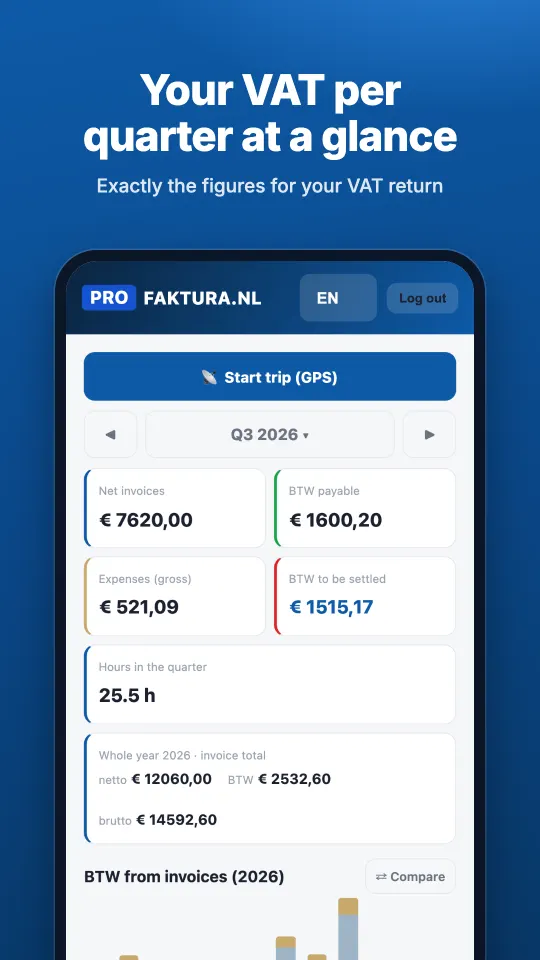
With Pro (€ 9.99 excluding VAT per month, 30 days free) the VAT dashboard shows your revenue, expenses and VAT to pay for each quarter. You record expenses with the receipt scanner, the GPS mileage log runs in the background, and the hours log counts towards the hours criterion. You export everything as PDF or CSV, and download the whole year as a ZIP archive. If you work with an accountant, they get free access after an invitation and download the whole quarter as a ZIP. See how that works in ProFaktura for accountants.
Frequently asked questions
What should a zzp freelancer do before 31 December?
Invoice your December work on time, complete your receipts and purchase invoices, update your mileage log and add up your hours on 31 December. If you want the KOR from 1 January, your application must arrive at least 4 weeks before the quarter, so by early December at the latest.
Does an invoice from late December count for this year or next year?
For VAT the invoice date usually counts, not the date your client pays. An invoice dated in December belongs to Q4 and to this year. You send an invoice by the 15th of the month after the work; if you issue it late, the sale belongs to the period in which it should have gone out at the latest.
When is the VAT return for the fourth quarter due in the Netherlands?
By 31 January, the last day of the month after the quarter. Your payment must also arrive by then. You file in Mijn Belastingdienst Zakelijk, and you correct a mistake in an earlier return with a suppletie.
When is the Dutch income tax return for 2026 due?
Usually by 1 May 2027. The exact date is in the letter from the Belastingdienst (aangiftebrief). If you cannot make it, request an extension (uitstel) before that date; the standard extension is 4 months.
Do admin and finding clients count towards the hours criterion?
Yes. The 1,225 hours include not only client work but also administration, acquisition, travel and training for your business. Keep your hours log all year, because it is your proof.
How long do I have to keep my business records in the Netherlands?
Receipts, sales invoices and purchase invoices are kept for 7 years, and records about real estate for 10 years. This also applies after you stop your business or switch software, so keep an export or archive.
Start the new year with your records in order
Create a free accountRead next: VAT return · hours criterion 1,225 · mileage log · KOR small business scheme